Home arrow 2-week expeditions arrow Altai - snow leopard

Print

Mountain ghosts: snow leopards and other animals in the mountains of the Altai Republic, Central Asia.

Price/dates/status

Talk me through this expedition

Independent This expedition won an award as one of the "Top Ten Outdoor Pursuits" in the Independent on Sunday.

These conservation working holidays will take you to the high mountains of Central Asia to survey snow leopards and their prey animals such as the argali mountain sheep and the Altai ibex, as well as other animals including marmots and birds. You will be working as part of a small international team from a base camp set at 2200 m at the foot of a 3500 m remote mountain range and overlooking a vast area of open steppe. You will be covering ground in Land Rovers and on foot, looking for tracks, kills, scats and the animals themselves. True expedition-style base camp conditions, testing but satisfying mountain surveying, off road driving, and variable mountain weather, make this our most challenging (and very rewarding) expedition. 

Snow leopardSnow leopardAltai ibexLandscape Climbing!Locals

PRICE = Expedition contribution (land only per slot)
£1480 (approx. €1880 | US$2940 | AU$3060).
Please note: expedition contributions are quoted in British pound sterling and the approximate Euro and US Dollar equivalent. Try the XE currency converter for other currencies and an up to date Euro and US Dollar exchange rate.
Where does my money go and other money questions.

Dates
2008*:  30 June - 12 July | 14 - 26 July | 28 July - 9 August | 11 - 23 August (12 nights).
2009**: 29 June - 11 July | 13 - 25 July | 27 July - 8 August (12 nights).
Team members can join for multiple slots (within the periods specified).
How long can I join for?

Status
*Red: Expeditions of status red have no spaces available (or have already been to the field). If an expedition is full already, you have the option of going on a waiting list. Please get in touch to add yourself to the waiting list.
**Green: Expeditions of status green have spaces available

Terrain
Open steppe and high mountains.

Weather expected during expedition
High mountain summer weather usually means hot sunshine during the day, but it can turn cold at any time of the year, including brief snow showers.

Expedition base
Tent camp of dome, mess and kitchen, as well as shower and toilet tents. Each team member has his/her own tent and there is hot water from the fire for showers.

Team size
Up to 12 team members + 1 local scientist + 1 expedition leader.

Skills & prerequisites required
None. You don't need to be a scientist or have any special qualifications - everyone can take part and there are no age limits whatsoever.
Can laypeople really be of help to serious research & conservation projects?

Fitness level required
Ability to walk about 2 – 15 km per day in mountainous terrain of 2000 – 2500 m altitude and ability to tolerate base camp altitude of approximately 2200 m. Those who feel able to can climb to higher altitudes of 2800 – 3500 m and spend the night in advanced observation camps. Those of lower fitness level can assist scientists near base camp or do vehicle-based work. Please note that medical evidence shows that altitude sickness is not usually a problem at altitudes below 3500 m.
Will it be for me or am I too old/young/unfit?

Team assembly point
Novosibirsk, third largest city in Russia..
What about carbon neutrality and other environmental and social impact?
Who books my flights?

And finally
Our expeditions are not about playing the primitive, neither are we a military style 'boot-camp'. Our expedition leader and the local scientist will be by your side and we believe strongly that we get the best out of our expedition teams by making them comfortable, safe and well fed. You won’t be living in the lap of luxury, but we will do our best to make you feel comfortable and at home in your working environment, as this is the key to a well-balanced and successful expedition.

Details


These conservation working holidays will conduct a survey of snow leopards as well as their prey species such as the argali (a mountain sheep with large ram horns and close relative of the Marco Polo sheep) and the Altai ibex. The expedition will also survey other animals such as marmots, birds and small mammals. The area is an important but unprotected corridor of snow leopard movement from Mongolia to Russia and next to nothing is known about these movements and snow leopard numbers. Data collected by this expedition will be crucial in the fight for wild snow leopard survival.

Aims & objectives

(1) To estimate snow leopard activity through field signs, by tracking and observation.
(2) To assess the status and distribution of their prey species like the argali and the Altai ibex.
(3) Where possible, to survey other animals such as marmots, birds and other small mammals.

Background

The Altai Republic sits in the very centre of central Asia between China, Mongolia, Kazakhstan, Russia and the Tuva Republic. In it, the Altai mountains rise from 350 to 4500 m and are one of the most beautiful, pristine and remote parts of the world. They were added to the list of natural World Heritage Sites in 1998 as an area of outstanding biodiversity of global importance and they provide the habitat for a number of endangered species including the snow leopard and manul (a small cat predator). It is, however, also one of the poorest regions of the former Soviet Union whose collapse has increased pressures on exploitation of natural resources and deprived local scientists of precious funds for biodiversity conservation.

Little is known about the status and distribution of the globally endangered snow leopard in the area and its interaction with prey animals like the argali and Altai ibex, and its reliance on smaller prey like marmots, ground squirrels and game birds. Biosphere Expeditions will provide vital data on these issues, which can then be used in the formulation of management and protection plans.

Study species

Snow leopard (Uncia uncia), Altai ibex (Capra sibirica), argali (Ovis ammon ammon)
 
Other (study) species, all in mountain habitats of granite cliffs, lakes and conifer forests - Mammals: marmot, ground squirrel, pika, manul, lynx, wolf, bear, wild boar, maral and other deer. Wolverine and other mustelids. Birds: the Altai harbours a very rich bird life, including black eared kite, upland buzzard, tawny eagle, imperial eagle, golden eagle, saker falcon, cinereous vulture, Altai snowcock, Demoiselle crane, greater sand plover, solitary snipe, Palla's sandgrouse, rose coloured starling.

Typical day

Activities are usually decided the night before and then confirmed in the morning, depending on the weather. The whole set-up of the expedition is quite flexible so that you can participate according to the weather conditions, your skills and general fitness and how you feel on the day.

Your typical day may consist of (1) taking your survey group’s Land Rover into the mountains to survey access points and from there searching in the mountains and valleys for snow leopards, argali, Altai ibex and their field signs, or (2) getting to a mountain observation point and spending the night there in search of snow leopard activity, using field scopes or camera traps where appropriate, or (3) finding and identifying other animals such as birds and small mammals by various means by night and day.

Most research groups will return to base for the night where food is prepared by the expedition cook. Please note that every member of the expedition can be rotated through all activities. There will also be rest and admin days as required.

Research area

The Altai mountains are one of the most beautiful, pristine and remote parts of the world, stretching across the very centre of central Asia between China, Mongolia, Kazakhstan and Russia, and standing at the junction of several natural zones and cultures. Few foreigners get to this corner of the world. Those that do, see a variety of stunning high mountain landscapes and immense spaces of open steppe framed by snow covered peaks. Belukha, the region’s highest mountain at 4506 m, rises just west of the research area and other mountain peaks, such as Tapduair (3505 m) and Sajlugem (3411 m), overshadow base camp.

The mountains are divided by several river valleys and there is a great variety of landscapes. There are hollows with semi-desert landscapes, Alpine peaks, narrow river canyons and broad valleys, highland tundra and deep natural limestone gorges, open steppes, permanent snow and glaciers and tracts of forest, as well as 7000 lakes, wild rivers and waterfalls. Forests of larch, cedar, spruce and pine (but very few deciduous trees) cover more than a half of the mountain territory.

Base camp itself is set amidst larch forest at the foot of Tapduair mountain and overlooking an area of open steppe. Many threatened animal and plant species, many of them endemic, are present in the area with a recent count showing at least 73 mammal species, 300 bird species, 44 fish species, 7 reptile species, a large number of invertebrates, and 1270 plant species.

Maps

Map 

Map of the region and study site.

Satellite map

Satellite close-up of study site with base camp (green dot) and snow leopard sign found (red dots). Sign includes tracks, scrapes, scats and sightings.

Google map 


Google map of all Biosphere Expeditions study sites, expedition bases, assembly points, office locations, etc.


Pictures

Snow leopard

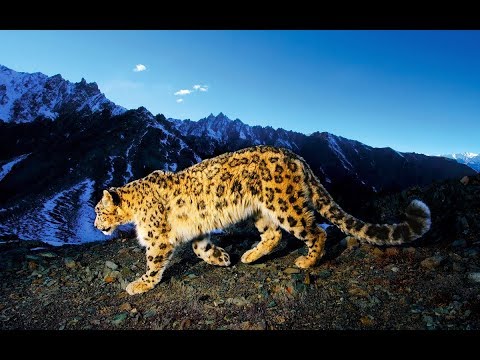
Snow leopard.

Snow leopard

Snow leopard caught in a camera trap.


Altai ibex

Altai ibex
(primary study species of the expedition).

Argali

Argali
(another primary study species of the expedition).

Suslik

Ground squirrel near base camp.

Eagle

Eagle's nest with fledgling inside.
Courtesy of Andy Stronach.

orel1

Steppe eagle.
(primary study species).

Demoiselle cranes


Demoiselle cranes.
Courtesy of Tessa McGregor.

Edelweiss1s

Edelweiss.

Sunflower

Sunflower
Courtesy of Andy Stronach.

Altai village

Altai village.
Courtesy of Andy Stronach.

Study site

Study site.
Courtesy of Tessa McGregor.

Study site

Study site.
Courtesy of Tessa McGregor.

Study site

Study site.
Courtesy of Tessa McGregor.

Land Rover

On the way to base camp.

Study site

On the way to base camp.
Courtesy of Andy Stronach.

Study site  

Valley leading up to base camp.
Courtesy of Tessa McGregor.

Base 

Location of base camp (red dot).

Base 

Base camp (bottom left) overlooking the steppe.
Courtesy of Andy Stronach. 

Base

Base camp. Expedition Land Rovers in the foreground, next to the yurt and red/grey dining tent. Dome tents for team members (one tent per person) left and right.
Courtesy of Tessa McGregor.

Base 

Base camp shower tents. Hot water from the fire and a great view!

Base

Breakfast.

Base

Dinner is served!
Courtesy of Andy Stronach.

Base

Downtime at base camp.
Courtesy of Andy Stronach.

Base

Camp fire.
Courtesy of Andy Stronach.

Advanced research camp

Advanced research camp.
Courtesy of Tessa McGregor.

Advanced research camp

 Advanced research camp.
Courtesy of Tessa McGregor.

Training

 Learning how to use maps, GPS and compass.
Courtesy of Andy Stronach.

Training

Learning how to use maps, GPS and compass.
Courtesy of Andy Stronach.

training4

Deciding on a survey route.

Briefing

Briefing before going out on a survey.
Courtesy of Tessa McGregor.

Work

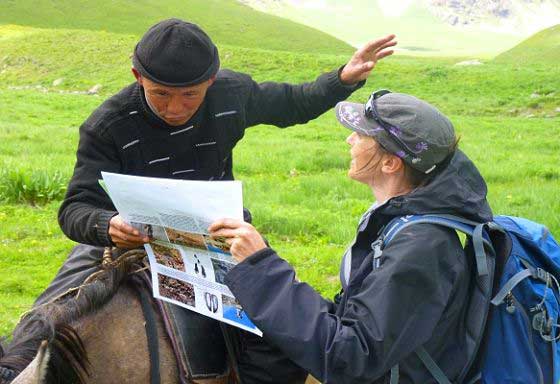
Conducting an interview with a local herdsman.

work10

Preparing a hide.
Courtesy of Tessa McGregor.

Work

Bird surveying.
Courtesy of Andy Stronach.

Work


Surveying.
Courtesy of Andy Stronach.

Work

Surveying.
Courtesy of Tessa McGregor.

Work

Surveying every nook and cranny Wink
Courtesy of Andy Stronach.

Work

Surveying a ridge.
Courtesy of Andy Stronach.

work7

High altitude observation point.

Work

Radioing in from the mountain top.
Courtesy of Tessa McGregor.

Work

 Sweeping a slope.
Courtesy of Andy Stronach.

Team

Team at the Altai border (the Cyrrilic reads "Respublika Altai").

Sunset  

Sunset & downtime after a day's work.
Courtesy of Andy Stronach.


Video

Altai landscapes (high mountains, valleys, steppe, etc.). The background music is Altai throat singing.

Putting up a yurt at base camp.

Clip from VOX TV, Germany, with cat biologist Tessa McGregor explaining the philosophy behind Biosphere Expeditions and how volunteers help with snow leopard conservation in the Altai.

YouTube Watch more Altai expedition
clips
on YouTube.  
 

Audio

BBC Radio 4 Radio 4 Nature
Feature on Altai expedition with Tessa McGregor, guest scientist on the expedition in 2003
in English

Press

Gobal

Here be snow leopards
in English
pdf View article 2.08 Mb

  Independent

On the prowl
in English
 pdf View article 3.98 Mb

 Rheinischer Merkur Wo steckt Leo?
in German
pdf View article 185.79 Kb

Outdoor

Spurensuche
in German
pdf View article 735.57 Kb

Ecotourisme Sur les traces du léopard des neige
in French
pdf VIew article 225.81 Kb
4x4 Club Altaian journey
in Russian
pdf View article 11.00 Mb
Geo On the trail of the snow leopard
in Russian
pdf View article 23.42 Mb 
Kommersant Ученые посчитают снежных барсов
in Russian
Go to article

Feedback

“It has always been our dream to conduct this kind of large-scale study. But so far we have had neither the money, nor the people to do it. Biosphere Expeditions has changed all that and enabled us to realise many of our ambitions. The data gathered, combined with the weight of Biosphere Expeditions' international reputation, will be vital in our efforts of protecting the area and its wildlife such as the elusive snow leopard.”
Volodymyr Tytar, local scientist, Altai.

“Being here as a travel journalist, this was one of the most exciting jobs I have ever had. Everything was perfect, the scenery, the team, the Russian supporters and especially the expedition leader who did a really good job.”
Uli Benker, 38

“This is my third expedition to the Altai and it just gets better every time.  Magnificent mountains, beautiful great valleys and wonderful people…”
Christine Newell, 59

"I'll never forget the first time we saw fresh snow leopard tracks...the whole group fell silent. We were all moved in a way we shared without speaking. I knew then this was something I would remember forever. We had a great team and achieved more than we ever anticipated. Being in the Altai was a unique experience which I'll never forget."
Martyn Roberts, 50.

Feedback from team members about their experiences and
reasons for coming (on/from various expeditions).

 “A great experience on many different fronts. Challenging surveys, great group of people, well organized and friendly from start to finish. The wildlife of the Altai needs Biosphere….”
Robin Glegg, 45

“Thank you for giving us such a great time in Altai. It was really an exciting experience to get to know this awesome landscape…”
Ian Wilson, 28

“After ten years in the desolate wasteland of 9 to 5 office work, these two weeks have been an amazing inspiration and a life changing event. I could not have hoped to meet better people and look forward to signing up for next year. Thanks to Biosphere Expeditions for making this an experience of a lifetime.”
Kathleen Ryan, 35

“This has been a wonderful first expedition for me and has lived up to all my expectations…”
Boris Piekarek, 40

“Thank you for a wonderful summer. The Altai is a beautiful region – the steppe and mountains are stunning. I feel privileged to have been able to spend so much time here and play a small part in the conservation of this fragile ecosystem.”
Maryse Agil, 51

“I will take away many fond memories – the views of the steppe in the morning and evening light, the changing colours of the hills as summer turns to autumn, my first sight of snow leopard tracks….”
Jens Warstat, 42

“This is an incredible area, one that may not remain the same for ever. I hope this expedition may give it a bigger chance. We were very lucky to see argali, ibex and much more. Fantastic laughs and a lot of fun. Thanks to the entire team who kept the camp….”
Camilla Eriksen, 22

“To be able to come out here, to a place so removed and different from my own, and to meet a local population with lives so different to mine, and to feel that we are working together without imposing ourselves – that is a feeling I’ll miss and the feeling I simply can’t convey to people who have not come here to experience it themselves.”
Katherine Munzel, 41

“It has been a fantastic opportunity to come to this part of the world and see landscapes that otherwise would be very difficult to access. My experience has been really good.”
Alan Franklin, 53

“What a great two weeks – full of excitement, adventure and driving lessons. Great time and a great group.”
Julianne Adams, 40
 
“Sitting around the stove in the yurt, eyes bright, the champers still bubbling, is a reflection of Expedition Altai – the larch shimmering as the sun illuminates the last raindrops, the camaraderie of a team that not only shares a love of the outdoors and the wild places of the world, but has bonded and laughed and cried together. A very memorable experience.”
Robin Burns, 63

“Excellent leadership allowed the team to quickly form a harmonious and happy working group.”
Martin Haslam, 60


Briefing


The expedition briefing contains very detailed information on this expedition, including instructions on how to get to the assembly point, what you will be doing whilst on expedition and who your expedition leader and scientists will be.

You can access briefings via the Download Centre.

Join

Go on, you know you want to Wink

Sign up here.


Feedback

Feedback


News

GONE TO AMBER
Oman 2009.
GONE TO AMBER
Honduras 2009.
NEW 2009 DATES
(April) for Azores 2009.
NEW 2009 DATES
(June) for Spain 2009.

NEW 2009 DATES
(Jun-Aug) for Altai 2009.


Awards


Newsletter


© Biosphere Expeditions, a non-profit organisation  
Terms | Sitemap
Site by D.V.S