
Home arrow 2-week expeditions arrow Namibia - leopard, cheetah, caracal

Print

Big cat conundrum: The challenge of protecting leopards, cheetahs and caracals in the Khomas Hochland of central Namibia.

Price/dates/status

Talk me through this expedition

This wildlife volunteering vacation will take you to the beautiful Khomas Hochland (highlands) in central Namibia to conduct a survey of African cats (leopard, cheetah, caracal, etc.) and their interrelationship with humans and prey animals (such as giraffe, eland, kudu, zebras, etc.). As part of a small team you will learn some bush skills and then follow collared cats on foot and in the expedition Land Rovers to record information about the animal’s behaviour. You will also conduct game counts and participate in community education and capacity-building work, which may vary from accompanying groups of school children out on game drives/hikes in the bush associated with conservation talks, to collecting demographic data. You may also assist with cat capturing and collaring. All this in an effort to mitigate human-wildlife conflict and create a sustainable future for all, and with the ultimate aim of creating a protected area in the Khomas Hochland.

CheetahLeopardCaracal Carrying a sedated cheetahLand RoverGame count

PRICE = Expedition contribution (land only per slot)
£1730 (ca. €1890 | US$2830 | AU$3090).
Please note: expedition contributions are quoted in British pound sterling and the approximate Euro and US Dollar equivalent. Try the XE currency converter for other currencies and an up to date Euro and US Dollar exchange rate.
Where does my money go and other money questions.

Dates
2010: 12 - 24 September | 26 September - 8 October | 17 - 29 October | 31 October - 12 November | 21 November - 3 December | 5 - 17 December (12 nights).
Team members can join for multiple slots (within the periods specified). How long can I join for? 

Status
Amber: Expeditions of status amber have few spaces available. To join them you need to decide soon, so please get in touch to talk about availability.

Terrain
Mixed African savannah and riverine habitat.

Weather expected during expedition
Semi-arid savannah climate. The expedition will be in Namibia when it is hot and mostly dry with temperatures from 35°C to 15°C.

Expedition base
Our base is a rustic, but comfortable bush camp style research base with safari tents with beds, linen, mosquito nets and basic furniture. There are hot showers, toilets, a communal lounge, rest areas with hammocks and a kitchen. Expedition team members will have their own tent and twin or double tents are also available on prior arrangement.

Team size
Up to 12 team members + 1-3 local scientists + 1 expedition leader.

Skills & prerequisites required
None. You don't need to be a scientist or have any special qualifications - everyone can take part and there are no age limits whatsoever.
Can laypeople really be of help to serious research & conservation projects?

Fitness level required
Low to moderate. Much of the work will be done from Land Rovers, but you may need to be able to walk for some distance in relatively hot conditions and in broken, mountainous terrain. Team members of lower fitness level or a condition that will prevent them from walking for long distances can take part in the vehicle-based tracking.
Will it be for me or am I too old/young/unfit?

Team assembly point
Windhoek, the capital of Namibia.
What about carbon neutrality and other environmental and social impact?
Who books my flights?

And finally
Our expeditions are not about playing the primitive, neither are we a military style 'boot-camp'. Our expedition leader and the local scientist will be by your side and we believe strongly that we get the best out of our expedition teams by making them comfortable, safe and well fed. You won’t be living in the lap of luxury, but we will do our best to make you feel comfortable and at home in your working environment, as this is the key to a well-balanced and successful expedition.

Details


This wildlife volunteering vacation will conduct a survey of African cats (leopard, cheetah, caracal, African wildcat and black-footed cat) and their interrelationship with humans and prey animals (such as giraffe, eland, kudu, Burchell’s zebra, mountain zebra, oryx, blue wildebeest, hartebeest, springbok, warthog, common duiker, steenbok, klipspringer) on a game farm in central Namibia. The main medium-term objective of the expedition is to gather scientific data that will enable us to provide both game as well as stock ranchers in central Namibia with reliable game and habitat management advice so that sustainable ways for African wildlife and human populations to coexist can be developed. To this end the expedition will capture & collar African cats and, once collared, monitor their behaviour and ecology. The expedition will also count game animals in an effort to develop reliable monitoring strategies. The expedition will also work with local people and landowners to build capacity, educate and develop joint solutions to combat the most significant threat to carnivore conservation in Africa today, namely human-predator conflict. The ultimate long-term goal is to create a reserve of 50,000 ha (500 km2) or more of un-fragmented protected land near Windhoek, thereby creating the biggest park bordering an African capital.

Aims & objectives

The main objective of this expedition is to gather scientific data that will enable us to provide both game as well as stock ranchers in central Namibia with reliable game and habitat management advice. To achieve this, the expedition will

(1) Opportunistically capture predators, especially leopard and cheetah (the dominant resident species), but also caracal, African wildcat, etc. for radio collaring and subsequent intensive monitoring of their daily movements, activities and behaviours.

(2) Evaluate the inter-predator (especially inter-species) relationships and the effect an abundance of a dominant species (e.g. leopard) has on the other predators (e.g. cheetah, caracal, jackal and African wildcat).

(3) Collect biological and diagnostic samples of all captured animals to evaluate the effect of human and domestic animal (especially dogs and cats) proximity on wild predators.

(4) Survey game populations, especially prey species, using different methods of game counts (road strip & waterhole counts, as well as infrared triggered cameras).

Background

Namibia has over 20 national parks and state protected areas, which cover more than 14% of the country and represent most important habitat types. Strangely enough, the only state protected area representative of the unique Namibian central highland area, locally called the Khomas Hochland, is the small 4,500 ha (45 km2) Daan Viljoen Game Reserve. Virtually the entire Khomas Hochland region is privately owned farmland used for extensive stock and game ranching. Many of these farmers have joined so-called conservancies, which aim to regulate the management and use of wildlife. However, due to relatively heavy predation on livestock and game species, most of the stock and game ranchers are intolerant of predators. Misconceptions about predator impact and numbers, prey densities, etc. abound. Land management practices are profit-oriented and based on stock farming principles. Needless to say, the overall management of conservancies is rarely ecologically sound. There is thus an urgent need to establish a bigger, well managed protected area representative of the central Namibian highland.

Study species

African leopard (Panthera pardus), cheetah (Acinonyx jubatus), caracal (Felis caracal), African wildcat (Felis libyca), Black-footed cat (Felis nigripes).

Other species present

The research area supports a high diversity of plant and animal species, because the Khomas Hochland, which predominantly consists of highland savannah, is also at the interface of the Kalahari to the east, Nama-Karoo to the south, thorn bush savannah to the north and escarpment to the west.

Amongst the roughly 70 different mammal species found in this area the following carnivores occur on Ongos: brown hyaena, black-backed jackal, Cape fox, bat-eared fox, banded and yellow mongoose. Other large mammals commonly seen on Ongos include white rhino, giraffe, eland, kudu, Burchell’s zebra, mountain zebra, oryx, blue wildebeest, hartebeest, springbok, warthog, common duiker, steenbok, klipspringer and numerous small species.

There are also a large number of man-made dams (artificial small lakes) that support a rich bird life (over 230 species).

Typical day

Your typical day begins early in the morning with breakfast at base camp. You will then split into your groups to complete the research tasks assigned to you for the day, interrupted by a lunch break with time for a siesta during the hottest part of the day. You will return to base for dinner and, on some days you may be out on a night game count. After supper we will conduct informal lectures and have discussions and brainstorming sessions concentrating on our research area as well as problems encountered.

In the event of an animal having been captured (or another exciting event), where possible all team members will be called together to witness and/or participate in the immobilisation/sample collection procedure.

Please note that every team member will be rotated through all activities and that most research groups will return to base for the night where food is prepared by the expedition cook. There will also be rest and admin days as required.

Capturing and collaring

The capture method of choice will be by cage trap, which is a safe way to capture the animals. Very occasionally we may end up dart immobilising free range animals with telemetry darts. You will check the cage traps daily by foot or using the expedition Land Rovers depending on the distance of the traps from the camp.

If an animal is captured, the group on duty will inform the rest of the team. All team members will then have the chance to join in and assist with or witness the handling of the captured animal. An animal that is captured for the first time will be darted, immobilised, and samples for research will be taken. After that, the animal will be fitted with a GPS collar and given an antidote to be released as soon as it has fully recovered.

Monitoring of primary study animals

Once an animal is collared, you will observe and study its movements and behaviour. This will be the main daily activity of at least one team. Depending on the number of collared animals within the study area at a given time, two teams may be assigned to this task. Team members will be provided with monitors and radio equipment and will work from Land Rovers, followed up by foot patrols under the leadership an experienced tracker.

You will follow collared animals on a 12 – 24 hour delay, based on downloaded GPS information and record information about the animal’s behaviour (preferred places to rest, drink, hunt from, preferred prey species, frequency of kills, etc.) and, where available, collect samples from kills as well as scat. Scat analysis will be used to obtain further insights into predation habits.

In the event of a sighting of a collared animal, you will do everything in your power not to alert or disturb the animal, but keep it under visual observation and record its natural behaviour.
 
Game counts

You will conduct two different types of game counts. A “road strip” count will be conducted from the Land Rover, during both day and night to ascertain game numbers and species, comparing also day and night activities of different game, especially nocturnal species, which includes most predators. The data thus gathered will, over time, yield valuable information concerning game numbers as well as seasonal habitat preferences of different species.

You will also conduct water hole counts during both day and night (and enjoy a night under an African starlit sky). Of primary interest here are population demographic data (e.g. male: female ratios, age composition of herds, number of sexually mature females with calf, etc.). This information is needed to ascertain the “herd health” of the various species and may yield further information regarding predation on target species. In the end our aim, with your help, is to establish a practically executable game count protocol that will both yield reliable and useful results and is within the financial means of the average game rancher.

Local community work

You will participate in community education and capacity-building work, which may vary from accompanying groups of school children out on game drives/hikes in the bush associated with conservation talks, to collecting demographic data.

Research area

At 825,418 sqkm Namibia is the world's thirty-fourth largest country. However, after Mongolia, Namibia is also the least densely populated country in the world (2.5 inhabitants per sqkm). Namibia is also very rich in wildlife. It has the largest cheetah population in southern Africa. There are over twenty species of antelope ranging from largest, the eland, to smallest, the Damara dik-dik. The oryx, a striking antelope with long symmetrical horns and distinctive black and white markings is featured on the Namibian coat of arms.

The heart of the current survey area will be the game ranch Ongos, which lies in the central Khomas Hochland. Ongos covers 10,000 ha (100 sqkm) of very well preserved nature representative of the highlands region. Even though Ongos is not far from Namibia’s capital Windhoek, it is separated  from the city by mountain ranges.

The farm has a very varied landscape (altitude range from 1500 – 2000 m) with many different habitat types ranging from typically African bushveld to riverine areas, including the constantly flowing Aretaragis river bordered by lush vegetation, to mountainous areas in the Khomas Hochland. Thus Ongos contains ideal habitats for all of the indigenous mammal species of Namibia, including elephant, rhino, buffalo and hippo. There are 22 ground dams (man-made lakes) fairly evenly distributed over the study area. Most are relatively small and only keep water for a few months after the rainy season but four dams hold their water for up to two years. The area has, for many years, not been used for any commercial farming activity, thus leaving the pasture and bush in prime condition. In addition to this, the area has a number of sites of archaeological interest (ancient village sites, caves with rock paintings, etc.).

Needless to say that the habitat diversity accommodates an equally rich diversity of fauna & flora and there are many typically African species present (giraffe, eland, kudu, Burchell’s zebra, mountain zebra, oryx, blue wildebeest, hartebeest, springbok, warthog, common duiker, steenbok, klipspringer and many smaller mammal species). We are currently raising two orphaned white rhino calves who are already roaming free in the study area and only come back to the house twice or three times a week. They will form the nucleus of the founder herd for white rhinos in the study area.

Partners

On this expedition we are working with the Namibian Ministry of Environment and Tourism, the United Nations Development Programme (UNDP), as well as other local authorities and communities. Land Rover, Swarovski Optik and Motorola also support this expedition.

Maps

Namibia

Map of the region and study site.

Google map 

Google map of all Biosphere Expeditions study sites, expedition bases, assembly points, office locations, etc.


Pictures

Leopard

Leopard
(primary study species).

Cheetah

Cheetah (primary study species).
This one with a radio collar already fitted.
Caracal  Caracal (primary study species).
Giraffe

Giraffe.

Kudu

Kudu.

Oryx

Oryx.

Springbok

  Springbok.

Zebra Zebra.
Meerkat Meerkat.
Porcupine Porcupine.
Warthog Warthog.
Aardvark Aardvark.
A lilac-breasted roller visting base  A lilac-breasted roller visting base.
Meeting the resident tame rhinos, part of a founder population for the study site Meeting the resident tame rhinos, part of a founder population for the study site.
Study site

The study site.

Study site

The study site.

Study site  Another sunset over the study site.
Introduction to the plan of daily research activities Introduction to the plan of daily research activities.
Training on how to look after the expedition Land Rovers Training on how to look after the expedition Land Rovers.
Another sunset over the study site

Tracking & counting game.

Mapping the study site

Mapping the study site.

On capture shift

Tracking a leopard.

Tracking a caracal Tracking a caracal.
Community work

Community work.

Tracking a collared cat Tracking a collared cat.
Transferring a sedated cheetah to the field lab for radio collaring

Transferring a sedated cheetah to the field lab for radio collaring.

Checking a sedated cheetah's heart rate Checking a sedated cheetah's heart rate.
A sedated leopard's paw

 A sedated leopard's paw.

Data entry at base Data entry at base.
Relaxing at base after a day's work

Relaxing at base after a good day's work Wink.

Safari tents and expedition Land Rovers

  Safari tents and expedition Land Rovers.

Safari tents

  Safari tents.

Expedition fleet

Expedition fleet.

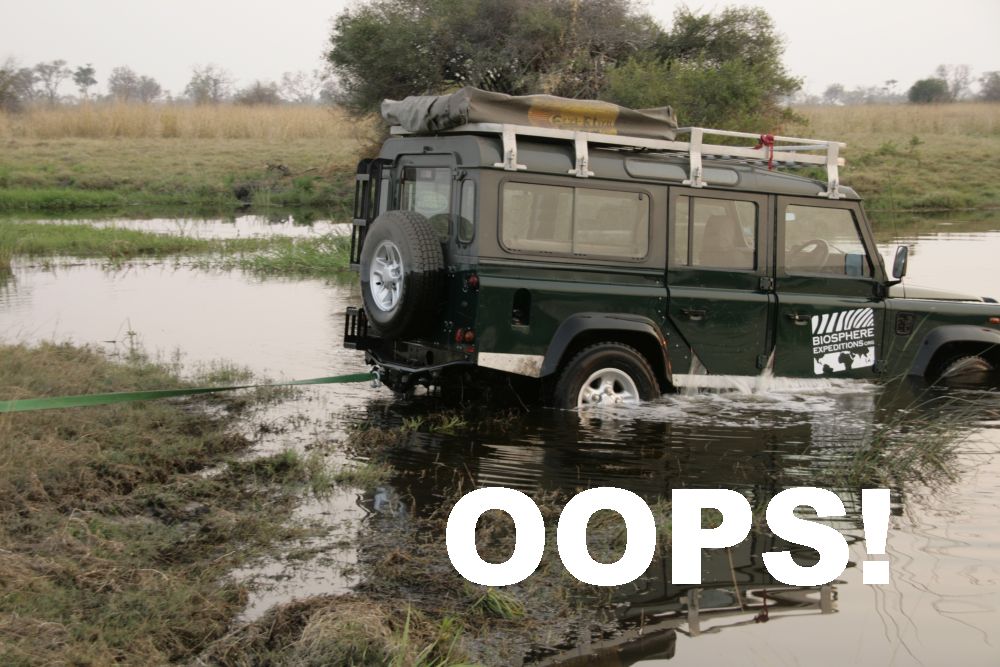
Ever so slightly stuck

 Ever so slightly stuck Wink

Curious leopard investigating an expedition Land Rover Curious leopard investigating an expedition Land Rover.
Sundowner

Sundowner.


More images on Biosphere Expeditions'  Picasa Web Album


Video

Capturing and radio collaring two leopards.

Three cheetah "hot releases". Hot release means that a captured animal is released without being sedated and having a radio collar fitted, usually because the animal is a re-capture and is already wearing a radio collar.

  Training for telemetry research activity.

YouTube Watch more Namibia expedition
clips
on YouTube.  

Audio

Deutsche Welle

Biosphere Expeditions' founder Dr. Matthias Hammer talks about how it all works and also about previous work on cheetahs in Namibia.
in English

Press

Please note that the articles below cover a previous cheetah, leopard & other carnivores conservation expedition in central Namibia. The expedition has since moved to a new location, but the articles below should give you a very good idea of what it's going to be like.

New Trail Erin McCloskey’s Namibian wildlife encounter
in English
pdf View article 124.30 Kb
Independent City boy animal instincts
in English
pdf View article 3.98 Mb
LTU Cheetah trail
in English
pdf View article 3.52 Mb
GeoSaison  Hilfreich im Tierreich
in German
pdf View article 1.43 Mb
Universum Geparde mit Sendungsbewusstsein
in German
pdf View article 594.46 Kb
Sonntag Aktuell Katzenjammer auf der Farm
in German
pdf View article 91.11 Kb
LTU Die Spur des Geparden
in German
pdf View article 6.53 Mb

Feedback

“Biosphere Expeditions' support of our research is a continuation of a great tradition where, they have, since 2002, been involved with various wild carnivore research projects in Namibia. Together we aim to research predator (especially leopard & cheetah) ecology to obtain a better understanding of these magnificent, but much-maligned cats predation habits and preferences. Our joint objective is to identify possible eco-friendly game management strategies that could minimise predation on high value game species and thus improve game ranchers' tolerance towards predators.”
Ulf Tubbesing & Kristina Killian, local scientists.

“A big thank you to all those involved in this wonderful project for giving us the chance to be part of it. I came with high expectations, which have been more than fulfilled. I leave with wonderful memories of the real wild Africa, not just of the game reserves I have visited before. The last two weeks have been an awe-inspiring experience with so many highlights! I hope your continued work is as successful as it has been so for and you are able to fulfil your aims.”

Eva Davey, 66.
 

Feedback from team members about their experiences and
reasons for coming (on/from various expeditions).

“I can’t find French words to tell you how fantastic this stay was for me so you can imagine in English! So thank you for making my dream come true and so memorable. Please just stay the way you are – it’s so good to meet people like you and all the work that you do.”
Géraldine Illien, 33.

"We really had a wonderful time and are very grateful for all your hard work. We had very high expectations for this expedition and they were all more than met; we would not hesitate to do something like this again, so you have not heard the last of us."
Jethro Frankenberger, 27 & Karolin Renkel, 26.

“The dynamics between the expedition leader, scientists, guides and cooks were outstanding, which really made the expedition go well. (…) It was amazing seeing conservation in action and it was especially the enthusiasm of the staff that brought the expedition alive.”
Marie Camus, 38.

“This has been the most wonderful period in my life and I am so glad to have had the opportunity to spend four weeks here. Many, many wonderful memories. Thank you Biosphere for making it all possible. All in all a very, very memorable and life-changing experience.”
Anne Evans, 48.

Briefing

The expedition briefing contains very detailed information on this expedition, including instructions on how to get to the assembly point, what you will be doing whilst on expedition and who your expedition leader and scientists will be.

Briefings are provided as pdf documents and you must provide a name, country of residence and valid e-mail address to be able to download one.

You can access briefings via the Download Centre.

Join


Go on, you know you want to Wink

Sign up here


Feedback

Feedback


News
10 YEAR ANNIVERSARY MAGAZINE
With conservation stories, opinions, outlook and Biosphere Expeditions' achievements over the last decade. pdf Download 6.79 Mb

NEW ACCOLADE
National Geographic Adventure "Best New Trips 2010" for Slovakia wolf & lynx project.


Awards


Newsletter
© Biosphere Expeditions, a non-profit organisation  
Terms | Sitemap
Site by D.V.SBiosphere Expeditions on Twitter Biosphere Expeditions on Facebook Biosphere Expeditions YouTube channel Biosphere Expeditions Wikipedia entry Biosphere Expeditions Picasa albums Biosphere Expeditions Flickr albums Biosphere Expeditions on Google maps